
 EN
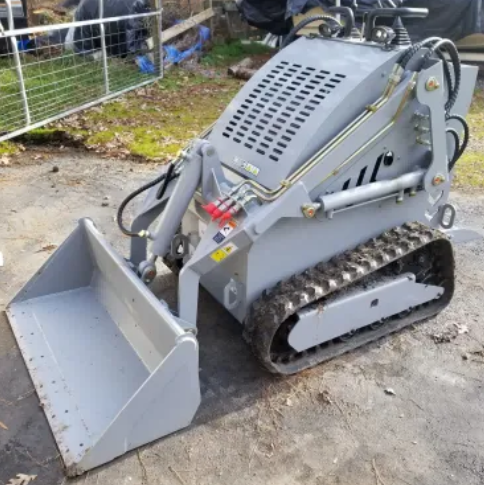
Mini Skid Steer Transport and Trailer Selection: Sizing, FMCSA Tiedown Rules, and Field Logistics
Key Takeaway: Transporting a mini skid steer safely requires balancing trailer Gross Vehicle Weight Rating (GVWR), loading ramp angle, and strict adherence to FMCSA 393.130 cargo securement rules. For most commercial operations, a tandem-axle utility trailer with a 7,000 to 10,000 lb GVWR, equipped with electric brakes and Grade 70 transport chains, represents the industry benchmark for safe, legal highway transport.
⚖️ Weight and Dimensions: Sizing the Transport Footprint
Before selecting a trailer, fleet managers must calculate the true wet weight and physical dimensions of the transport load. A mini skid steer’s dry chassis weight represents only a fraction of the actual trailered payload. To find the true trailered weight, you must start with the base chassis dry weight, add the fuel, hydraulic fluid, and operator to get the operating wet weight, and finally add any attachments such as a high-torque auger or bucket.
Most commercial mini skid steers, such as the Toro Dingo or Bobcat MT series, fall into a specific physical envelope:
-
Compact Class (1,500 to 2,200 lb): Features an overall machine width of 32 to 36 inches, fitting easily through standard gates. Requires a minimum trailer deck length of 10 to 12 feet and can be towed by a 1/2-Ton Pickup.
-
Heavy-Duty Class (2,300 to 3,500 lb): Features an overall machine width of 38 to 44 inches for high-flow models. Requires a minimum trailer deck length of 12 to 14 feet and is best towed by a 3/4-Ton Pickup.
A major benefit of 36-inch-wide mini skid steers is the ability to load them perpendicular or sideways on flatbed trailers when carrying multiple light implements. However, when doing so, the total width must remain strictly under the standard DOT limit of 102 inches to avoid requiring expensive permits or escort vehicles.
? Trailer Comparison: Flatbed vs. Step-Deck vs. Enclosed
Selecting the correct trailer configuration is a trade-off between loading speed, bridge clearance, and security.
| Trailer Type | Key Engineering Advantages | Critical Field Limitations | Best For |
|---|---|---|---|
| Flatbed / Utility | Lowest cost; easy side-loading of attachments; shallow ramp angle. | Cargo remains exposed to weather and potential job-site theft. | Daily landscape contractors with high-frequency moves. |
| Step-Deck (Drop-Deck) | Lowers center of gravity; reduces loading height by 12 to 18 inches. | Shorter flat deck surface; higher empty trailer weight. | Transporting high-profile units with vertical masts. |
| Enclosed Cargo | Maximum protection against weather, road salt, and job-site theft. | High ramp angle; tight spaces make tie-down strapping difficult. | Multi-day projects where tools are stored in the trailer overnight. |
? FMCSA Securement: 4-Point Tie-Down Engineering
Insecure cargo is a major safety and legal liability. Under FMCSA Part 393.130, heavy equipment weighing under 10,000 lb must be secured using a minimum of four independent tie-downs (one at each corner), plus separate securement for any heavy attachment such as a hydraulic breaker or trenching arm.
Chains must be connected to the skid steer's yellow-painted, factory-welded tie-down loops—never around hydraulic cylinders, auxiliary lines, or the boom arm. Always utilize Grade 70 Transport Chains (minimum 5/16-inch diameter) or heavy-duty synthetic webbing straps rated for a minimum Working Load Limit (WLL) of 5,000 lb.
Use heavy-duty ratchet binders rather than lever-type binders. Lever binders can kick back violently during tensioning and are more susceptible to loosening under highway vibrations. Keep tie-down angles between 45 and 60 degrees relative to the trailer deck to provide equal resistance against both horizontal sliding and vertical bouncing.
?? Field Case Study: Overcoming Trailer Sway and Lack of Traction
During a highway transport run in Pennsylvania, a crew was hauling a 2,800 lb tracked mini skid steer on a single-axle landscape utility trailer behind a half-ton pickup. While traveling at 55 mph, the driver experienced severe trailer sway.
An inspection revealed that the crew had loaded the machine with the heavy diesel engine facing rearward at the very back of the deck to make room for a pile of hand tools up front. This placement reduced the trailer's tongue weight to less than 2% of the total load, lifting weight off the truck's rear traction tires. Furthermore, during morning loading under light rain, the tracked machine had slipped sideways on the wet, smooth wood ramps, nearly sliding off the edge of the trailer.
To rectify this, the crew re-positioned the skid steer forward on the deck, ensuring the heavy engine sat ahead of the trailer axles to achieve a measured 12% tongue weight (approximately 450 lb on the hitch ball), which immediately eliminated the highway sway. Additionally, the smooth wood ramps were replaced with heavy-duty steel mesh ramps equipped with welded traction cleats to provide mechanical grip for rubber tracks in wet or muddy conditions.
? Pre-Transport Logistics and Inspection Checklist
Before pulling onto public highways, the transport driver or safety coordinator must complete this safety audit:
| Verification Item | Engineering Standard | Verification Method |
|---|---|---|
| Tongue Weight | 10% to 15% of total trailer and cargo weight | Verify hitch compression; check truck rear suspension sag. |
| Braking System | Dual-axle electric brakes functioning correctly | Test trailer breakaway switch cable; check in-cab brake controller output. |
| Tire Inflation | Inflated to max cold PSI listed on trailer tire sidewall | Physical pressure gauge verification. |
| Attachment Securement | Lowered flat on deck; secured with an independent strap or pin | Physical shake test to verify zero vertical movement. |